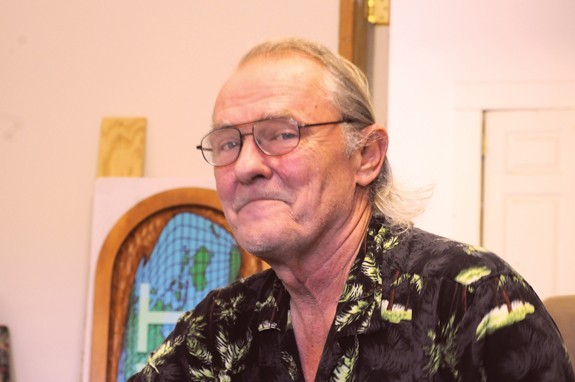
Paul Pantone
Inventor. Visionary. Martyr.
"It works. That's the problem.
They don't want it to work."
1950 – 2015
Paul Pantone dedicated his life to developing a technology that could have changed the world. In return, he was charged with fraud, declared insane, and locked away in a mental institution for three and a half years. He died in 2015, never having received justice or vindication. But his technology lives on, built by thousands around the world.
This is the story of a man who could have become wealthy beyond measure if he had simply sold his invention to the highest bidder. Instead, he gave it away for free. And for that choice, the system destroyed him.
A Mind for Invention
Paul Pantone was born in 1950 in Detroit, Michigan, the heart of American automotive manufacturing. Even as a child, he displayed an unusual aptitude for invention. In his teenage years, he built various practical tools "without knowing he was inventing" - including a "stud gun" for splitting firewood and a glow-in-the-dark level with 27 different functions.
In 1959, his family relocated to Southern California. After high school, Pantone worked as a carpenter — humble work that would unexpectedly set the stage for one of the most consequential inventions of the twentieth century.
It was during the energy crisis of the late 1970s that Pantone's inventive mind turned to the problem consuming America: the high cost of oil and its devastating environmental impact. He became obsessed with finding a better way. By his own account, he discovered "over 250 ways of NOT getting better mileage or less pollution" before finally achieving breakthrough.
The Birth of GEET
In 1983, Pantone created his first working GEET engine. The technology was deceptively simple in concept: by using exhaust heat to pre-process fuel and creating a unique plasma reaction within a specially designed reactor chamber, ordinary internal combustion engines could run more efficiently, produce dramatically fewer emissions, and operate on alternative fuel mixtures - including those containing significant amounts of water.
"GEET Fuel Processor could be called a new type of carburetor with a miniature refinery built in." Paul Pantone
In 1984, Pantone unveiled GEET at the Extraordinary Technology conference, becoming "an instant hero in certain circles." The following year, he was featured on the evening news. That's when the threats began.
The First Threats
After his 1985 television appearance demonstrating GEET, Pantone began receiving death threats. This would become a recurring pattern throughout his career - increased visibility always followed by increased danger.
Scientific Validation
Despite the threats, Pantone continued developing and demonstrating his technology. In 1987, testing was conducted at Briggs and Stratton's facility in Waukesha, Wisconsin. In 1994, during a California smog certification demonstration, GEET exhaust was allegedly measured as cleaner than the ambient air entering the system.
Perhaps the most significant validation came in July 1995, when physicist Dr. Andreas Kurt Richter spent a week with Pantone observing GEET demonstrations firsthand. His conclusion was remarkable:
"According to my present knowledge it should not work and I would not believe it had I not seen it with my own eyes." Dr. Andreas Kurt Richter, Physicist - July 3, 1995
On August 18, 1998, after years of development and documentation, Paul Pantone was awarded US Patent #5,794,601 for his "Fuel Pretreater Apparatus and Method." The patent validated that his device was real, functional, and sufficiently novel to warrant federal protection.
"Fuel Pretreater Apparatus and Method"
Granted: August 18, 1998
A Gift to Humanity
Here is where Paul Pantone's story diverges from that of a typical inventor seeking wealth and recognition. In 1998, the same year his patent was granted, Pantone and his son David made an extraordinary decision: they released free GEET plans "for everyone on the planet."
This wasn't naive idealism. Pantone had reportedly been offered millions to sell GEET rights to corporate interests. According to supporters, these offers came with an implicit understanding: the technology would be shelved, never to threaten the oil industry's dominance. Pantone refused.
"The goal is to use GEET to wipe out pollution and reduce the cost of living up to 95% for all of humanity." Paul Pantone
Pantone stipulated that any sale of his technology must ensure "the invention be used to help man." No buyer could meet that condition to his satisfaction. So instead of selling, he gave it away. He established schools to teach GEET technology. He created a corporation not to profit but to spread the invention worldwide.
For powerful interests invested in the fossil fuel economy, this decision made Paul Pantone far more dangerous than any competitor could ever be.
The Persecution Begins
Around 2000, according to Pantone and his advocates, the pressure intensified. When he continued to refuse buyout offers, the threats became explicit. Former business partners turned adversarial. His marriage collapsed.
On October 3, 2003, the Utah Department of Commerce issued a cease and desist order against Pantone. He was charged with:
- Four second-degree felony counts of Securities Fraud
- One third-degree felony count of Securities Fraud
- One third-degree felony count of Selling an Unregistered Security
- One second-degree felony count of Pattern of Unlawful Activity
The allegations centered on claims that Pantone had defrauded investors of more than $200,000 by selling GEET stock illegally. Supporters maintain that these charges were manufactured by former associates who had actually embezzled funds and created bogus stock certificates, then reported Pantone to authorities to cover their own crimes.
On October 8, 2004, facing the full weight of the state's legal apparatus, Pantone pled guilty to two counts of securities fraud. The other charges were dismissed.
A Coerced Plea
According to supporters, Pantone accepted the plea under duress after his attorney threatened him with a two-year mental ward sentence plus life imprisonment if he didn't comply. What followed proved those fears prescient.
The Utah State Hospital
Following his guilty plea, the machinery that would destroy Paul Pantone began to turn. Rather than proceeding to sentencing, questions were raised about his mental competency. On December 12, 2005, Judge Royal Hansen declared Pantone incompetent to stand trial and ordered him committed to the Utah State Hospital.
The grounds for this determination were telling. According to court documents, Pantone exhibited "grandiose and persecutory delusions." Among the evidence of his "delusions": his belief that GEET could run engines on mostly water.
He was declared insane, in part, for believing his own patented invention worked.
What followed was not treatment. It was destruction.
Conditions of Confinement
According to advocates and multiple published accounts, Pantone endured horrific conditions during his 3.5 years at Utah State Hospital:
- A broken toe left untreated for over 18 months
- Hepatitis C that went untreated
- Persistent migraines, skin rashes, and bleeding sores
- Rotten teeth - some broken in half, some fallen out - with infected gums
- Additional broken bones in his feet requiring orthopedic surgery
- Forced to drink from a dirty communal water container
- Rumors circulated among inmates that he was a pedophile, leading to beatings
Pantone was denied phone and visitation rights despite judge's orders. His outgoing mail was intercepted. Only certified mail reached him - and then it was taken away.
The Forced Medication Threat
The state sought to forcibly medicate Pantone with antipsychotic drugs to make him "competent" for sentencing. These medications could cause diabetes, uncontrollable irreversible muscle spasms (tardive dyskinesia), stroke, and cardiovascular failure.
Dr. Wilfred Higashi, a former head of Utah state mental health who had been Pantone's therapist for ten years, warned that patients on such medications became "zombies with tardive dyskinesia." The court dismissed his evaluation as "biased."
"What good is a lawyer when you've got a judge that is not playing fair? Let the man go." George Gaboury, Paul Pantone Defense Project
Freedom, At Last
On May 12, 2009, after three and a half years of incarceration, Paul Pantone was finally released from Utah State Hospital. The state agreed to let him leave without additional jail time - he had already served longer than any prison sentence would have required.
His son David was instrumental in securing his release by publishing audio interviews that demonstrated Paul had "full mental faculty and was being mistreated."
"Paul Pantone is FREE... an American hero who has survived horrific inventor abuse by corrupt Utah officials and businessmen."
San Francisco Tesla Society - May 2009
Pantone emerged from the hospital a broken man physically, but his spirit remained undefeated. He relocated to Stephens County, Oklahoma, where a friend parceled off several acres. There, he built a compound where he continued teaching GEET technology to anyone who wanted to learn.
The Final Years
Despite everything that had been done to him, Pantone never stopped working to spread GEET technology. In July 2009, just two months after his release, he appeared on Coast to Coast AM with George Noory, announcing the release of free plans for large engine GEET conversions.
He continued giving interviews and presentations, including featured speaking engagements at TeslaTech conferences in 2011 and 2014. He taught classes at his Oklahoma compound and answered questions from builders around the world.
In August 2015, reports emerged that Pantone had been attacked and robbed. He continued giving interviews through that autumn - on Dark City Radio, Feet to the Fire, and Pateo Radio. His final interview was on September 16, 2015.
Death
On December 14, 2015, Paul Pantone died in Murfreesboro, Tennessee after suffering from a prolonged illness. He was sixty-five years old. His body was cremated and his ashes scattered over the Pacific Ocean.
"On the 14th day of December 2015, beloved father, super-genius, inventor, and crusader for globally inclusive prosperity, Paul Pantone passed from physical to aetherical existence."
— GEET International
Paul Pantone never received justice. He never saw his persecutors held accountable, and he never witnessed the widespread adoption of his technology that he believed could transform human civilization.
But he also never surrendered. He never sold out, and he never stopped fighting.
Legacy
Today, Paul Pantone's son David continues his father's mission through GEET International Institute. The free plans Paul released in 1998 remain available online. Thousands of people around the world have built working GEET systems.
In France, the "Gillier-Pantone" variant has achieved particular success. French farmers have modified their tractors with SPAD kits, reporting 30-60% fuel savings. Commercial GEET kits are available throughout Europe. Academic studies continue to document the technology's effectiveness.
The technology cannot be suppressed because Paul Pantone refused to let it be owned. By giving GEET to the world, he ensured that no corporation or government could ever truly kill it. That was his final victory.
"I thank my dad Paul Pantone for dedicating his life to the betterment of all future generations of humanity, all creatures, and nature in general, and for all the sacrifices he made to create and perfect GEET." David Pantone
In Memoriam
Paul Pantone could have become rich. Instead, he chose to give his invention to humanity. For that choice, he was persecuted, institutionalized, and ultimately destroyed.
He believed that clean, affordable energy was a human right - not a privilege to be rationed by those who profit from scarcity. He paid the ultimate price for that belief.
Paul Pantone
1950 - 2015
"It works."
Honor His Sacrifice
The best way to honor Paul Pantone's memory is to build what he created, share what he gave, and ensure that his sacrifice was not in vain.
Primary Sources
- US Patent #5,794,601 - Fuel Pretreater Apparatus and Method
- Salt Lake City Weekly - "Fuel Injected Lunatic" (2007)
- Deseret News - "Pollution-Free Device Powered by Amazing Fuels" (1996)
- ExtraOrdinary Technology - "Embattled Scientist On the Edge of Deletion" (2006)
- GEET International Institute - Official organization continuing Pantone's work